Showing posts with label Popular. Show all posts

Friday, April 27, 2012

Conductors and Composers of Popular Orchestral Music: A Biographical and Discographical Sourcebook

Conductors and Composers of Popular Orchestral Music: A Biographical and Discographical Sourcebook Review
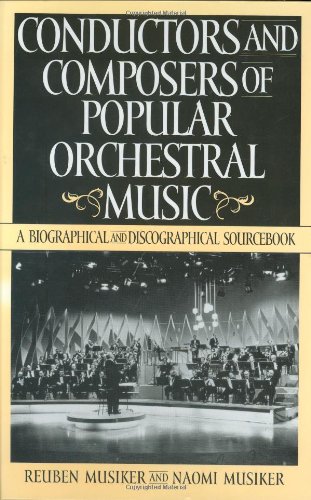


Worldwide in scope and covering the second half of the 20th century, this work provides biographies and discographies of some 500 conductors and composers in many aspects of light and popular orchestral music, including film, show, theatre, and mood music. This is the first time the lives and recordings of such artists as Kostelanetz, Faith, Gould, as well as the orchestral recordings of such great popular composers as Gershwin, Kern, Porter, Rodgers, Berlin, and Coward, have been adequately documented and consolidated in an encyclopedic fashion. Almost 5,000 records and CDs are listed. Of interest to scholars, students, disc jockeys, record and CD collectors, film music buffs, and mood and production music enthusiasts.

Popular orchestral music has been a neglected and often erroneously perceived and misunderstood genre in the 20th century. It has certainly not received the attention that it deserves and seems to be viewed as a Cinderella in relation to classical music and jazz. The genre, especially in the last 50 years, has been graced by exceptionally fine and highly esteemed conductors and arrangers, and also by a large number of highly regarded composers.


Friday, February 10, 2012

Popular Songs: Orchestra Play-Along Volume 1

Popular Songs: Orchestra Play-Along Volume 1 Review


Popular Songs: Orchestra Play-Along Volume 1 Feature

  • ISBN13: 9781423445739
  • Condition: New
  • Notes: BRAND NEW FROM PUBLISHER! 100% Satisfaction Guarantee. Tracking provided on most orders. Buy with Confidence! Millions of books sold!
This exciting new series lets you play along with a real orchestra! Each pack includes ten pieces with individual parts arranged for violin, viola, cello, and bass plus a professionally recorded CD with a full orchestra. Pick your part, turn on the CD, and play along like a pro! Volume 1 includes: Big Spender * Breaking Free * Eleanor Rigby * I Will Always Love You * It Don't Mean a Thing (If It Ain't Got That Swing) * Pie Jesu * Start of Something New * We're All in This Together * We've Only Just Begun * Whistle down the Wind.


Friday, December 9, 2011

The Big Band Reader: Songs Favored by Swing Era Orchestras and Other Popular Ensembles

The Big Band Reader: Songs Favored by Swing Era Orchestras and Other Popular Ensembles Review


Take a walk down memory lane with The Big Band Reader!

Benny Goodman, Cab Calloway, Count Basie, The Dorsey Brothers, Duke Ellington, and Glenn Miller were musical masters of their eras, enchanting and romancing audiences with their timeless classics. Relive these wonderful songs and memories through The Big Band Reader: Songs Favored by Swing Era Orchestras and Other Popular Ensembles, a unique and exciting collection of over 140 songs from over 70 bands that are categorized by themes, preferred numbers, and top songs! Paying tribute to better known swing bands, sweet bands (ensembles favoring softer, more sentimental numbers), and some unheralded bands (good ensembles that did not receive much attention or did not have a well-known leader), this book offers music enthusiasts up to four biographical essays relating to specific groups and their popular hits, giving you historical and informative facts about the songs and the people who performed them.

Nostalgic and entertaining, The Big Band Reader is a one-of-a-kind book that provides you with specific details and research about your most cherished songs and their composers, such as:
  • The Artie Shaw Orchestra, well-known for their classic hit “Begin the Beguine,” by composer and lyricist Cole Porter
  • The Benny Goodman Orchestra and their crowd favorite “And the Angels Sing,” written and composed by Johnny Mercer
  • The Billy Eckstine Orchestra's well-loved songs, including “Prisoner of Love,” written by Leo Robin and “A Cottage for Sale,” written by Larry Conley and composed by Willard Robison
  • “Day in Day Out,” with words and music by Johnny Mercer and Rube Bloom, which was a favorite of three big bands orchestras, Tommy Dorsey, Artie Shaw, and Bob Crosby
  • Cab Calloway of the Cab Calloway Orchestra, along with Jack Palmer, and their hit “Jumpin’Jive”

    Thorough and fascinating, The Big Band Reader includes an appendix of the big bands arranged by themes to help you find a desired song or group. This remarkable reference will enable you to walk down memory lane and reminisce about the unforgettable songs of swing and its composers.


Friday, October 7, 2011

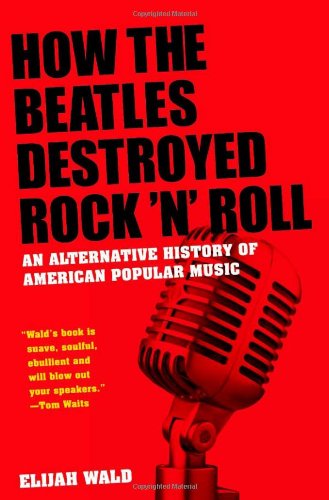
How The Beatles Destroyed Rock 'n' Roll: An Alternative History of American Popular Music

How The Beatles Destroyed Rock 'n' Roll: An Alternative History of American Popular Music Review


Overthrowing the conventional pieties of mainstream jazz and rock history, Elijah Wald traces the evolution of popular music through developing tastes, trends and technologies--including the role of records, radio, jukeboxes and television--to give a fuller, more balanced account of the broad variety of music that captivated listeners over the course of the twentieth century.

Wald revisits original sources--recordings, period articles, memoirs, and interviews--to highlight how music was actually heard and experienced over the years. In a refreshing departure from more typical histories, he focuses on the world of working musicians and ordinary listeners rather than stars and specialists. He looks at the evolution of jazz as dance music, and rock 'n' roll through the eyes of the screaming, twisting teenage girls who made up the bulk of its early audience. Duke Ellington, Benny Goodman, Frank Sinatra, Elvis Presley, Chuck Berry, and the Beatles are all here, but Wald also discusses less familiar names like Paul Whiteman, Guy Lombardo, Mitch Miller, Jo Stafford, Frankie Avalon, and the Shirelles, who in some cases were far more popular than those bright stars we all know today, and who more accurately represent the mainstream of their times.

"Wald's book is suave, soulful, ebullient and will blow out your speakers."
--Tom Waits

"Wald is a meticulous researcher, a graceful writer and a committed contrarian.... An impressive accomplishment."
--Peter Keepnews, New York Times Book Review

"One of those rare books that aims to upend received wisdom and actually succeeds."
--Kirkus Reviews

"It is as an alternative, corrective history of American music that Wald's book is invaluable. It forces us to see that only by studying the good with the bad--and by seeing that the good and bad can't be pulled apart--can we truly grasp the greatness of our cultural legacy."
--Malcolm Jones, Newsweek

"Wald wears his scholarship lightly, but his ideas and insights are substantial.... The attention-grabbing title, for all its counterintuitive appeal, gives scant indication of the book's ambitions and achievements."
--David Suisman, The Sixties


Wednesday, June 8, 2011

Black Music in Britain: Essays on the Afro-Asian Contribution to Popular Music (Popular Music in Britain)

Black Music in Britain: Essays on the Afro-Asian Contribution to Popular Music (Popular Music in Britain) Review


What is "black music"? Do all musicians play it? Can whites play "black music"? These are difficult yet fundamental questions which Paul Oliver addresses at length in this volume, which places the contribution of black musicians to popular music in its socio-historical contexts. Part 1 concentrates upon the background from 1800-1950 including 19th-century attitudes to "black music", the first encounters with jazz, and the introduction of West-Indian calypsos. Part 2 considers the 1950s to the present, examining music by Africans in Britain, the influence of steelband music, and the popularity of "bhangra" dance music among young Asians, and the maintainance of the "gawwali" tradition. Several contributors have written chapters which aim to define and clarify this variety of types and styles. They consider educational, sociological and historical perspectives, as well as examining the responses of the media and the recording industry to black music.