Showing posts with label Culture. Show all posts

Tuesday, February 7, 2012

Swingin' the Dream: Big Band Jazz and the Rebirth of American Culture

Swingin' the Dream: Big Band Jazz and the Rebirth of American Culture Review
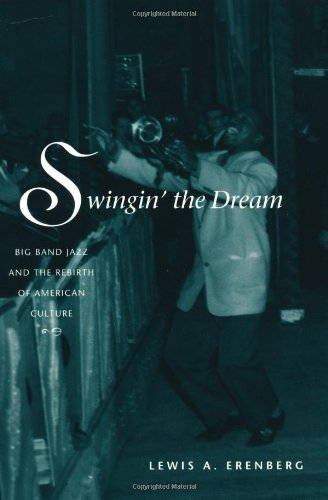


During the 1930s, swing bands combined jazz and popular music to create large-scale dreams for the Depression generation, capturing the imagination of America's young people, music critics, and the music business. Swingin' the Dream explores that world, looking at the racial mixing-up and musical swinging-out that shook the nation and has kept people dancing ever since.

"Swingin' the Dream is an intelligent, provocative study of the big band era, chiefly during its golden hours in the 1930s; not merely does Lewis A. Erenberg give the music its full due, but he places it in a larger context and makes, for the most part, a plausible case for its importance."—Jonathan Yardley, Washington Post Book World

"An absorbing read for fans and an insightful view of the impact of an important homegrown art form."—Publishers Weekly

"[A] fascinating celebration of the decade or so in which American popular music basked in the sunlight of a seemingly endless high noon."—Tony Russell, Times Literary Supplement


Friday, July 29, 2011

The Hidden Musicians: Music-Making in an English Town (Music Culture)

The Hidden Musicians: Music-Making in an English Town (Music Culture) Review


A landmark in the study of music and culture, this acclaimed volume documents the remarkable scope of amateur music-making in the English town of Milton Keynes. It presents in vivid detail the contrasting yet overlapping worlds of classical orchestras, church choirs, brass bands, amateur operatic societies, and amateur bands playing jazz, rock, folk, and country. Notable for its contribution to wider theoretical debates and its influential challenge to long-held assumptions about music and how to study it, the book focuses on the practices rather than the texts or theory of music, rejecting the idea that only selected musical traditions, "great names," or professional musicians are worth studying. This opens the door to the invisible work put in by thousands of local people of diverse backgrounds, and how the pathways creatively trodden by amateur musicians have something to tell us about both urban living and what it is to be human. Now with a new preface by the author, this long-awaited reissue of The Hidden Musicians will bring its insights and innovations to a new generation of students and scholars.


Thursday, June 23, 2011

Musical Metropolis: Los Angeles and the Creation of a Music Culture, 1880-1940

Musical Metropolis: Los Angeles and the Creation of a Music Culture, 1880-1940 Review


This fascinating cultural history of music in Los Angeles focuses on orchestral performance from the late nineteenth century through World War II. Decentralization defined Los Angeles's growth since the late nineteenth century, and because the central city did not dominate the city's music culture as was the case in cities of the East and Midwest, a greater diversification of music emerged. Performers and audiences included Latinos, Euro-Americans, Asian Americans, and African Americans, but the notion of diversity in the late nineteenth- and early twentieth-century city went well beyond ethnicity--it also included a "media diversity," as the city's musical output was presented through a variety of channels including recordings, radio, and film. These media strongly influenced the musical culture of Los Angeles, which in turn influenced the musical culture of America at large as the city grew into the nation's epicenter of entertainment. The book features a CD providing examples of much of the music examined. In addition, there are further support materials on the author's website: http://faculty.ulv.edu/~marcusk